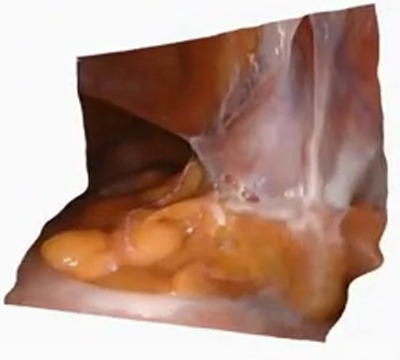
MICCAI · Surgical Scene Reconstruction

PhysioSplat

Physics-Informed Dynamic Gaussian Splatting
for Surgical Scene Reconstruction

Hritam Basak1,2 Zhaozheng Yin1
1Stony Brook University  ·  2Amazon.com
View Code
0PSNR · EndoNeRF
0SSIM
0Physics models
SoTAon 3 benchmarks
scroll ↓
The idea

Existing 4D Gaussian Splatting treats a surgical scene as one big bag of moving blobs — ignoring that it is governed by physics. PhysioSplat injects three physical priors into the splatting process, so reconstruction stops hallucinating and starts respecting reality: rigid tools are separated from soft tissue, deformations stay biologically plausible, and wet-surface highlights no longer explode into floaters.

Method

Three physics, one splat field

Hover a pillar — each addresses a failure mode that purely-visual 4DGS cannot.

01
⚙️

Kinematic

Physio-Semantic Disentanglement

Splits Gaussians into a rigid tool field and a deformable tissue field. A learnable semantic logit routes each primitive to rigid SO(3) motion or a non-rigid hex-plane field — enabling tool removal and recovery of occluded anatomy.

PSGD · Eq. 1–2
02
🧬

Biomechanical

Differentiable Regularization

An As-Rigid-As-Possible strain energy, a tool–tissue collision repulsion, and a volume-preservation term keep the deformation field on the manifold of biologically plausible tissue motion — no collapse, no interpenetration.

DBR · Eq. 3–6
03

Optical

Specular-Aware Appearance

Endoscope light is co-located with the camera. PhysioSplat decomposes radiance into diffuse + view-dependent specular, with normals read from the rendered depth gradient — stabilizing highlights on wet, reflective tissue.

SAAM · Eq. 7
📹Endoscopic videoRGB · tool mask · depth
⚙️Disentangletool vs. tissue
🧬Regularizebiomechanics
Renderspecular-aware
🫀Tool-free 4D sceneanatomy recovered
Drag to compare

PhysioSplat vs. prior SoTA

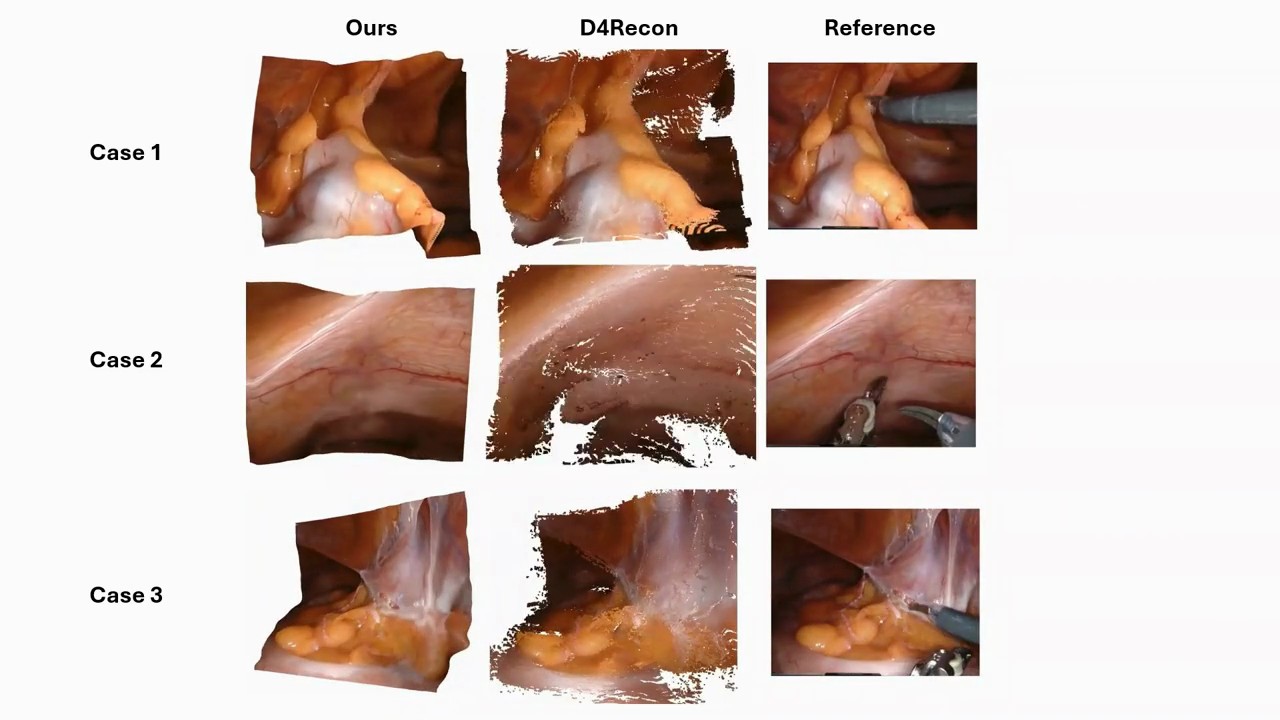
Same case, same viewpoint. Drag the handle — prior work shatters into floaters where ours stays a clean, continuous surface.

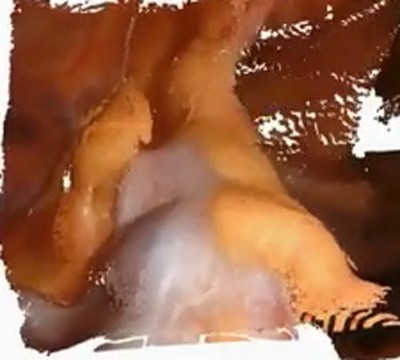
D4Recon reconstruction with floaters, case 1
PhysioSplat reconstruction, case 1
Ours D4Recon
Case 1
D4Recon reconstruction with floaters, case 2
PhysioSplat reconstruction, case 2
Ours D4Recon
Case 2
D4Recon reconstruction with floaters, case 3
PhysioSplat reconstruction, case 3
Ours D4Recon
Case 3
Qualitative results

From occluded video to clean 4D anatomy

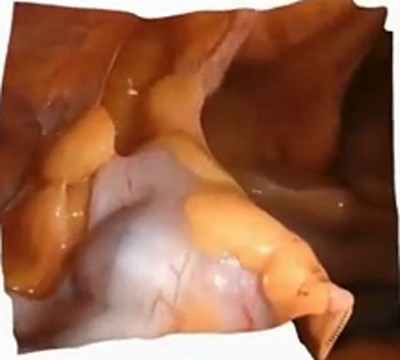
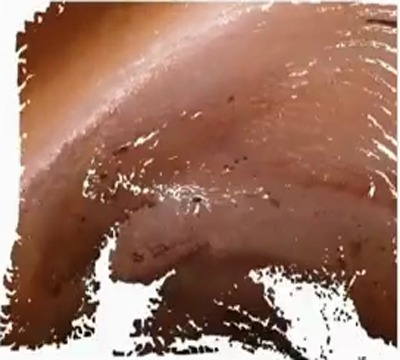
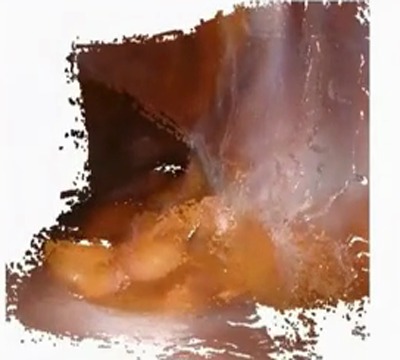
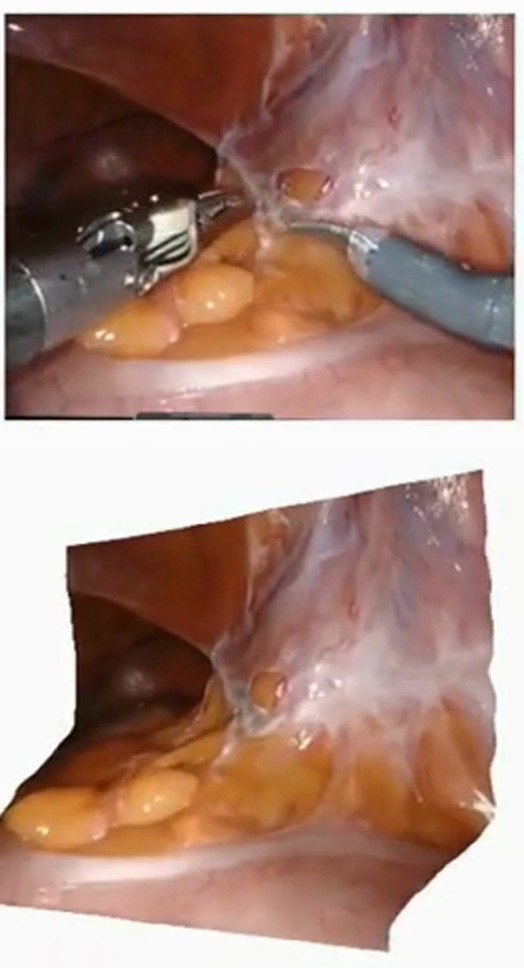
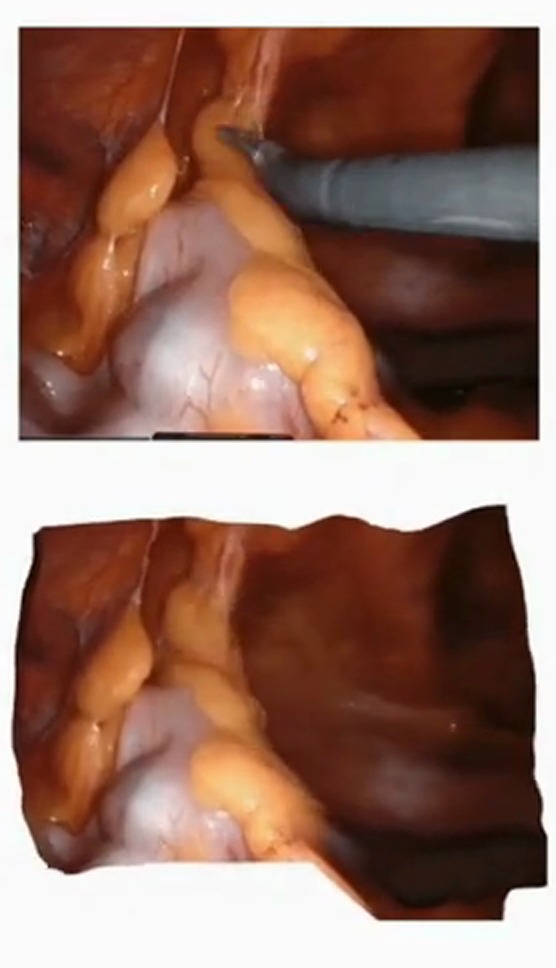
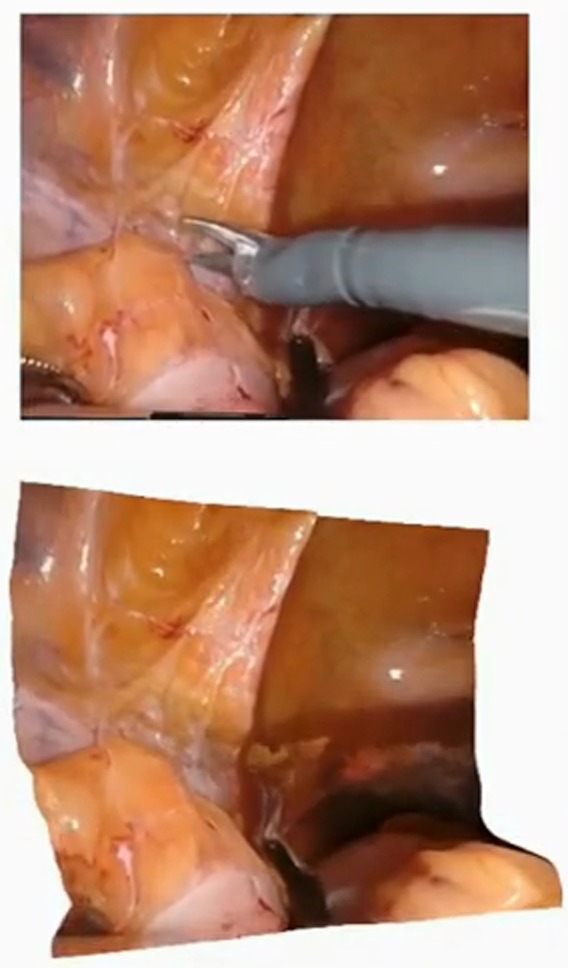
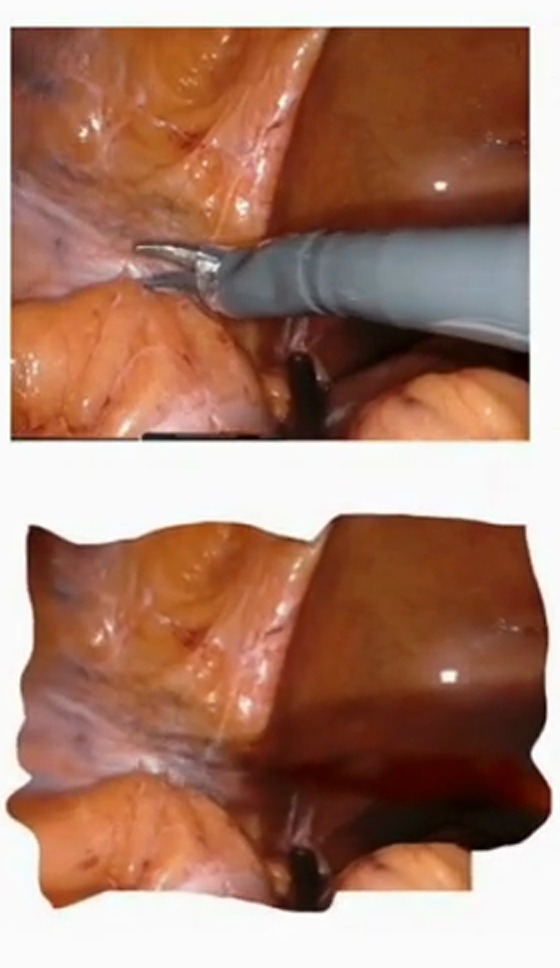
Tool removal & anatomy recovery. Each card pairs an input frame (top, with occluding instruments) and PhysioSplat's reconstructed 3D model (bottom) — instruments erased, the tissue behind them recovered.

Case 1: input with tools above, tool-free 3D reconstruction below input3D model
Case 1
Case 2: input with tools above, tool-free 3D reconstruction below input3D model
Case 2
Case 3: input with tools above, tool-free 3D reconstruction below input3D model
Case 3
Case 4: input with tools above, tool-free 3D reconstruction below input3D model
Case 4

Dynamic viewpoint rendering

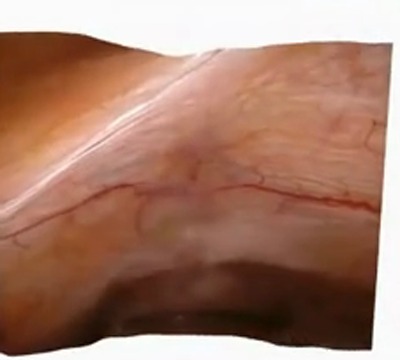
The green pyramid is the moving camera frustum. Because tool and tissue are disentangled, the full geometry is recovered free of camera occlusion — and can be re-rendered from novel views.

Reconstructed surfaces re-rendered from a moving virtual camera (green frustum), plus the complete tool-free 3D scene — recovered without camera occlusion.

Comparison & ablation

Ours vs D4Recon vs Reference
vs. state of the art. Ours · D4Recon · reference. Prior work leaves geometric noise and floaters; PhysioSplat reconstructs coherent surfaces.
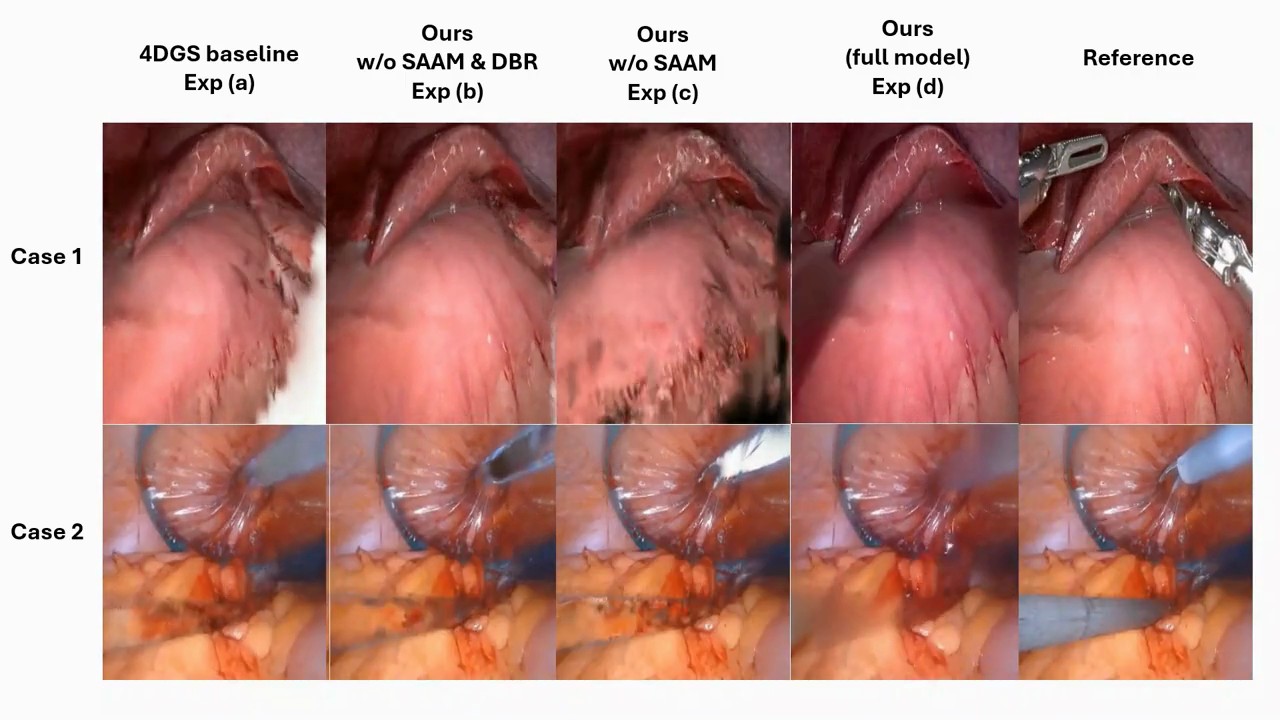
Ablation across 4DGS baseline, w/o SAAM and DBR, w/o SAAM, full model, reference
Ablation. 4DGS baseline → +PSGD → +DBR → full model. Each physical prior tightens geometry and suppresses artifacts, converging to the reference.
Quantitative

State of the art on every benchmark

PSNR ↑ on the four evaluation splits. Bars animate when in view.

EndoNeRF-Cutting
D4Recon 40.13
Ours 42.80
EndoNeRF-Pulling
D4Recon 39.98
Ours 41.60
StereoMIS
D4Recon 35.03
Ours 37.20
SCARED
EndoGaussian 26.89
Ours 29.75
36.2
4DGS baseline
+
38.7
+ PSGD
+
40.4
+ DBR
+
42.8
+ SAAM · full

Component ablation (PSNR, EndoNeRF-Cutting) — each physical model contributes.

Run it

Reproduce in three commands

bash
# clone & install
git clone https://github.com/hritam-98/physiosplat.git
cd physiosplat && pip install -r requirements.txt && pip install -e .

# run the built-in synthetic demo — no data needed
python examples/run_synthetic.py

# train on your own EndoNeRF-style scene
python scripts/train.py --data /path/to/scene --iterations 30000 --device cuda
Cite

BibTeX

physiosplat.bib
@inproceedings{basak2026physiosplat,
  title     = {PhysioSplat: Physics-Informed Dynamic Gaussian Splatting
               for Surgical Scene Reconstruction},
  author    = {Basak, Hritam and Yin, Zhaozheng},
  booktitle = {Medical Image Computing and Computer Assisted Intervention (MICCAI)},
  year      = {2026}
}